Campuslife Educative
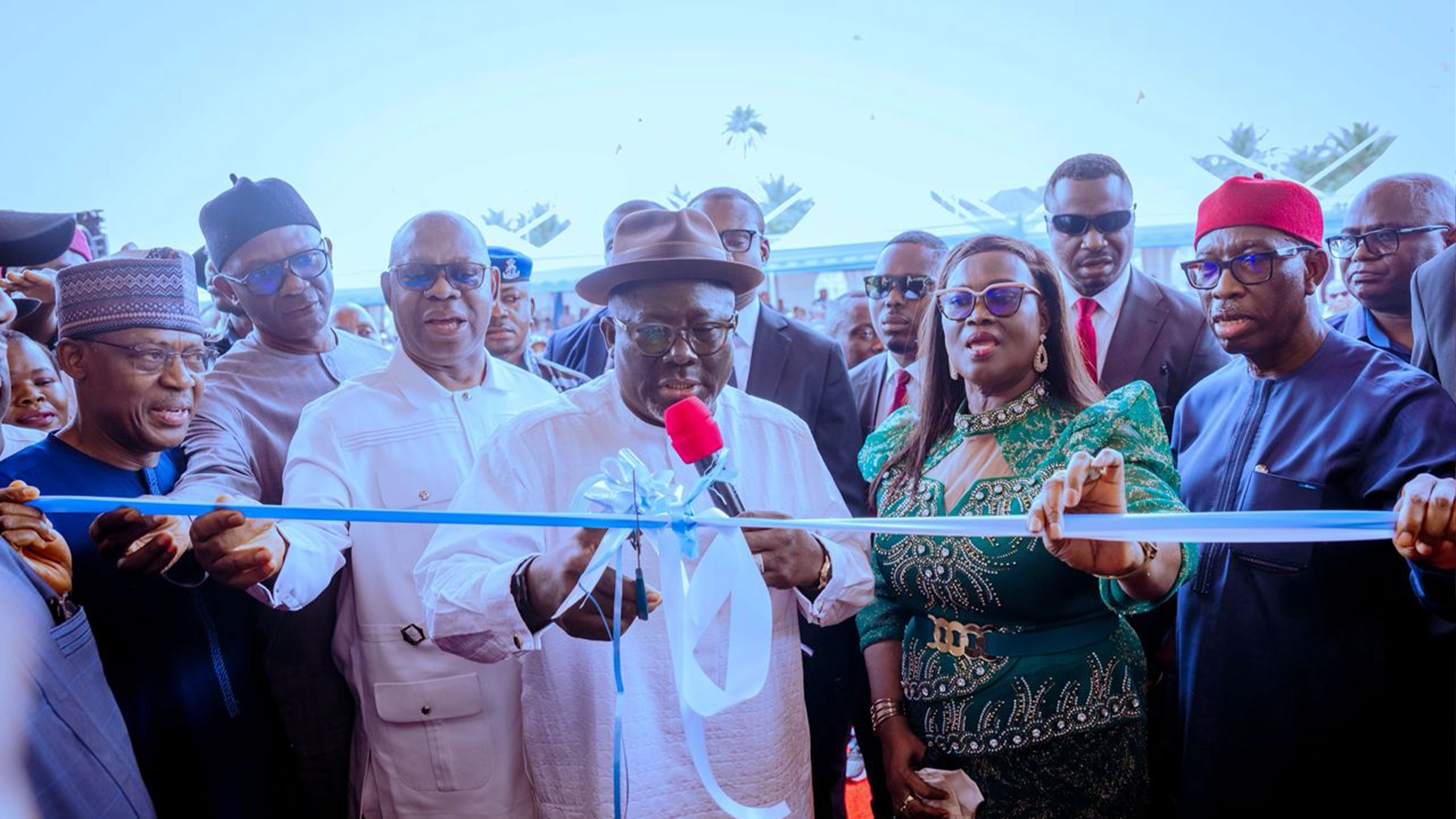
Delta State Governor, Sheriff Oborevwori (middle), cutting the ribbon to commission the ultra modern faculty of Environmental Sciences building, University of Delta, Owa-Alero Campus on Friday, while the former Acting Executive Secretary, National Universities Commission (NUC), Chris Maiyaki (left), Deputy Governor, Sir Monday Onyeme (2nd left), and immediate past Governor of the State, Senator Ifeanyi Okowa (right) look on. PHOTO: BRIPIN ENARUSAI
By the time the applause settled at the University of Delta (UNIDEL), Agbor, Owa-Alero Campus, it was clear that the moment represented more than the commissioning of new buildings. It was a statement of intent, a declaration that Delta State’s development story is being written simultaneously in concrete, classrooms, communities and character.
Governor of Delta State, Sheriff Oborevwori, stood before a gathering of students, lecturers, political leaders, traditional rulers and community stakeholders to inaugurate a cluster of landmark projects: The Faculty of Management and Social Sciences Complex (named after him), the Faculty of Environmental Sciences building, the Faculty of Engineering Lecture Hall and Workshops, a 500-seater central auditorium and a fully equipped central library.
He described the occasion as a “harvest of projects,” but the symbolism ran deeper than bricks and mortar. For Oborevwori, education is not an afterthought to infrastructure; it is infrastructure.
The story of UNIDEL is intertwined with Oborevwori’s legislative past. As Speaker of the Delta State House of Assembly, he was part of the process that led to the establishment of three state universities (University of Delta, Agbor; Dennis Osadebay University, Asaba and Southern Delta University, Ozoro) in a single day, a rare feat that reshaped access to higher education in the state.
At the time, Delta State University, Abraka, faced severe admission limitations. With over 25,000 qualified applicants competing for roughly 5,000 approved slots from the National Universities Commission (NUC), thousands of capable students were left stranded each year. The creation of additional universities was not political ornamentation; it was a response to a generational crisis.
Today, UNIDEL alone hosts about 17,000 students. Former governor Ifeanyi Okowa, who initiated the university, reflected on the broader impact. Without those opportunities, he suggested, many of those young people might have been left vulnerable to unemployment, frustration and social instability. Access to education, in that sense, is not merely academic; it is preventive, stabilising and transformative.
Standing inside the newly commissioned facilities, the scale of ambition becomes evident. The Sheriff Oborevwori Complex houses lecture rooms, offices, a student resource centre, media facilities and a 250-seat auditorium. The Environmental Sciences Faculty includes two 250-seat auditoriums, classrooms, studios, staff offices, a faculty library and a 150-capacity seminar room.
The Engineering Complex boasts workshops for metalwork, carpentry, mechanics, foundry and welding, alongside a 200-capacity engineering studio. The Central Library seats 426 students; the main auditorium accommodates 500.
Vice-Chancellor of the university, Prof. Stella Chiemeke, captured the significance succinctly: “You are not just constructing buildings; you are constructing the future of Delta State.”
Oborevwori himself emphasised that point, urging students to protect the facilities and pursue their studies with discipline and integrity. The goal, he said, is not to produce job seekers alone but job creators prepared for a knowledge-driven economy.
The governor’s education advocacy extends beyond public infrastructure. At Government House, Asaba, he recently received the Managing Director of Midwestern Oil and Gas Company Limited, Mrs. Elozino Olaniyi, commending the company’s sustained investment in scholarships and youth capacity development.
For Oborevwori, the private sector must complement government efforts. He praised Midwestern’s scholarship programme, which has supported 298 students this year alone with over $2 million invested, covering secondary and tertiary education, including beneficiaries studying in the United States and Latvia.
“Investing in students today secures the future of our state tomorrow,” he said, underscoring that growth in the energy sector must go hand in hand with social responsibility.
The governor also highlighted the company’s environmental discipline and safety record of over seven million man-hours without a Lost Time Injury, noting that transparency and environmental stewardship are non-negotiable in oil-producing regions.
In this synergy between state policy and corporate citizenship lies a broader theme of his administration – development must be collaborative, accountable and sustainable.
Beyond classrooms and scholarships, Oborevwori’s development blueprint places heavy emphasis on strengthening institutions. During the swearing-in of Mr. Sebastian Okoh as Managing Director of the Delta State Structures for Signage and Advertisement Agency (DESAA) and Chief Stanley Kakor as Director-General of the Delta State Local Content Agency, the governor framed their appointments as strategic to economic diversification and reform.
DESAA’s mandate to regulate and monitor outdoor advertising structures might seem technical, but in a fast-growing economic corridor like Delta, visual order translates into investment confidence. Curbing indiscriminate signage is as much about aesthetics as it is about compliance and revenue optimisation.
The Delta State Local Content Agency, on the other hand, touches directly on economic justice. By domesticating provisions of the Nigerian Oil and Gas Industry Content Development and Monitoring Act, the agency mandates up to 70 per cent local content utilisation in extractive industries and ensures companies honour Memoranda of Understanding with host communities.
For Oborevwori, strict compliance reduces conflict, fosters trust and keeps wealth circulating within Delta communities. His charge to the new appointees was clear – fairness, transparency and alignment with the MORE Agenda – his administration’s development framework.
If education builds intellectual capital, infrastructure builds physical access. And in Delta State, the governor has made it a point to personally inspect projects rather than rely solely on reports.
During an inspection of the 12.12-kilometre Ugbolu-Okpanam Road, Oborevwori stressed that groundbreaking ceremonies mean little without diligent follow-up. Designed with extensive drainage systems to combat chronic flooding, the road features 7.7-metre-wide concrete drains and an eight-metre carriageway, with water channels engineered to redirect runoff safely into nearby rivers.
The attention to drainage is deliberate. Okpanam’s elevation historically pushed flood waters into surrounding areas, damaging property and disrupting livelihoods. By insisting on comprehensive and durable drainage infrastructure, the administration aims to deliver long-term solutions rather than cosmetic repairs.
At the Oko-Anala–Oko-Ogbele–Oko-Odifili Road project, the terrain posed additional engineering challenges, requiring removal of unstable clay soil before stabilisation. When contractors projected a 2027 completion date for Phase Two, the governor rejected the timeline, insisting on faster delivery.
“We believe in standards, and we will not compromise on quality,” he declared, linking performance to future contract opportunities. The message is consistent: Public funds must yield durable value.
Development, in Oborevwori’s narrative, is not purely structural; it is spiritual and social. When Dr. Chris Kwakpovwe, founder of Manner Prayer Mountain Ministry Worldwide and author of the widely read ‘Our Daily Manner’ devotional, paid him a courtesy visit, the governor spoke about leadership as divinely ordained and dependent on collective prayer and goodwill.
He urged Nigerians to uphold unity and pray for leaders at all levels, including President Bola Ahmed Tinubu. Governance, he noted, thrives not merely on policy but on moral support and shared responsibility.
Chris, reflecting on the 26-year journey of the devotional, described leadership support through prayer as a biblical mandate. He praised the governor’s people-centred approach and pledged continued intercession.
In a state as diverse as Delta, where ethnic, economic and political interests intersect, unity becomes not just aspirational rhetoric but a necessary foundation for sustained growth.
The symbolism of unity found vivid expression when Delta State received the Torch of Unity for the Second Niger Delta Games. Represented by his deputy, Sir Monday Onyeme, Oborevwori framed the torch as more than ceremonial flame; it was a beacon of peace, youth engagement and regional integration.
Sports, the administration maintains, offer one of the most effective channels for steering young people away from social vices while nurturing discipline, teamwork and excellence.
Over 4,000 athletes from across the Niger Delta are set to compete in 16 sporting events in Benin City. Delta State has completed rigorous local and state trials to ensure strong representation. For the government, participation is more than medals; it is about building ambassadors of hope.
Taken together, these strands – education, corporate partnership, institutional reform, infrastructure, spiritual engagement and youth empowerment – weave a multi-dimensional portrait of governance.
Oborevwori’s administration has often been associated with visible infrastructure such as flyovers and bridges. Yet beneath the asphalt and concrete lies a broader philosophy: Development must be balanced, inclusive and forward-looking.
Universities expand intellectual opportunity. Scholarships widen access. Roads connect markets and communities. Regulatory agencies instill discipline. Local content laws protect economic participation. Sports unify. Prayer strengthens moral resolve.
For the students settling into lecture halls at UNIDEL, the impact is immediate and tangible. For contractors racing to meet revised deadlines, accountability is non-negotiable. For corporate leaders investing in scholarships, partnership is strategic. For athletes preparing for regional games, opportunity beckons.
In each sphere, the underlying message is consistent: The future of Delta State is being built deliberately in minds, in markets and on motorways.
And as the applause faded at Owa-Alero, what remained was not merely the echo of ceremony, but the quiet conviction that governance, at its best, is about constructing possibilities, structures that endure long after the ribbon is cut.